
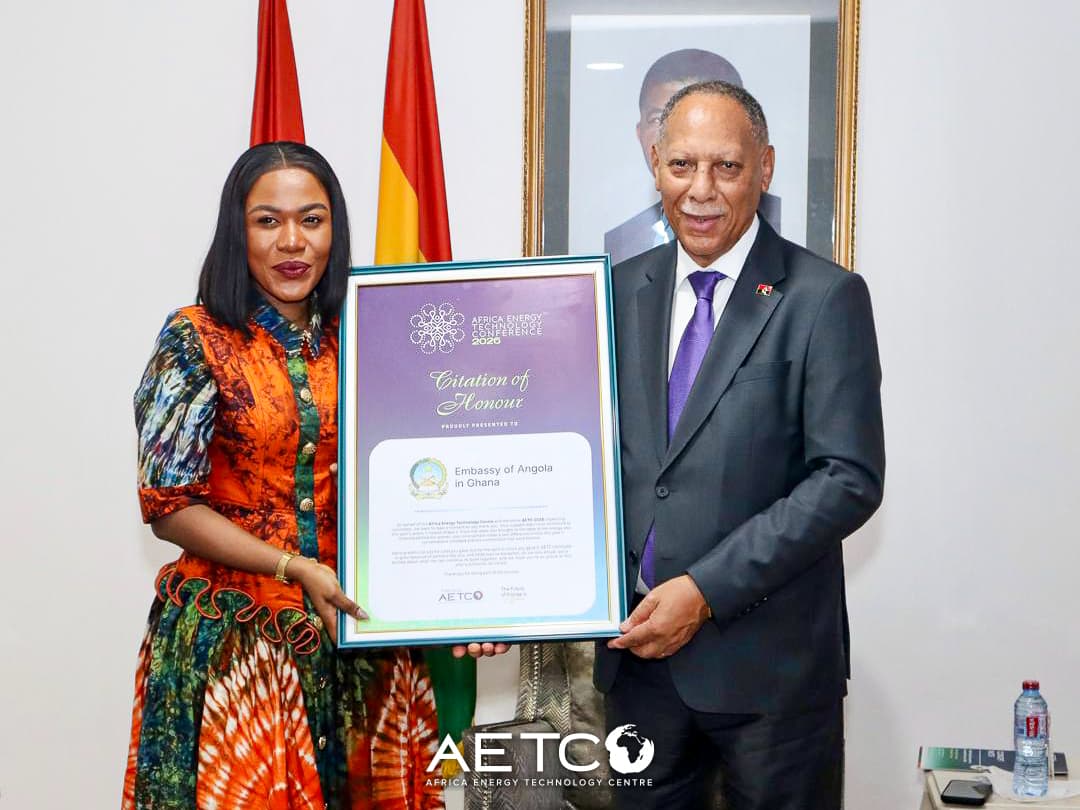

The Africa Energy Technology Centre (AETC), led by its Founder and President, Ms. Emelia Akumah, paid a courtesy visit to His Excellency Rui Orlando Xavier, Ambassador of Angola to Ghana, in a further step to strengthen strategic partnerships that advance Africa'senergy transformation through collaboration, technology, innovation, and investment.
The visit provided an opportunity to reflect on Angola's participation in the Africa Energy Technology Conference 2026 and to explore areas of cooperation that could deepen engagement between AETC and Angolaahead of AETC 2027. Discussions centred on energy, technology, youth development, investment, and the strengthening of institutional and government-level cooperation.
Angola's Expanding Role in Africa's Energy Landscape
Angola's growing influence in Africa's energy sector presents substantial opportunities for collaboration. As the continent's second-largest crude oil producer, the country has built considerable expertise in deepwater and ultra-deepwater operations, with exploration and production activities concentrated in Blocks17, 15, and 31, amongothers.
In recent years, Angola has undertaken a sweeping reform of its upstream sector.Its exit from OPEC in January 2024 removed the production quotas that had capped output at roughly 1.11 million barrelsper day, giving operators greaterlatitude to pursuerecovery strategies free of external constraints. Since then, the national oil, gas and biofuels regulator, ANPG, has run a multi-year licensing programme launched in 201U, awarding35 of a targeted50 onshore and offshore blocksand drawing more than $60 billion in existing investment commitments, with tens of billions more anticipated from a furtherlicensing round opening from 2026. A revised fiscal framework under Presidential Decree 8/24 featuring a 15 percent royaltyrate, a 70 percent cost-recovery ceiling, and a 25 percent profit-oil allocation cap for the state has been widely regarded by industry analysts as competitive by international standards, reinforcing Angola's attractiveness to global operators. Collectively, these reforms have helped underpinwhat analysts now describe as a roughly $70 – 100 billion investment pipeline reshaping the country's energy proposition heading into 2026.

Angola is also diversifying decisively beyond crude. Production began in March 2026 at the Quilumaand Maboqueiro fields under the Chevron-led New Gas Consortium whose partners include TotalEnergies, Eni, BP, and Sonangol marking the country's entry into non-associated gas production and building on Azule Energy's earlier gas discovery at Block 1/14. The Consortium is investing approximately $4 billion to expandgas processing capacity at the Soyo industrial complex,a project expectedto increase feed gas supplyto the Angola LNG plant, support domestic power generation, and enable new industrial applications such as the conversion of natural gas into ammoniaand urea for domestic and regional markets. In parallel, Angola's downstream regulator is working to expand opportunities across refining, storage, and LPG distribution as the country seeks to strengthen domestic fuel security and reduce import dependence.
Offshore, new agreements, farm-ins, and frontier studies are reinforcing Angola's deepwater basins as a strategic growth zone for global operators. The Kaminho FPSO development, for which Siemens Energy is building an 80 MW power generation plant, is scheduled to come online in 2028, while projects such as KON-16 advancing toward a mid-2027 drilling campaig and continued production growth at Block 15/06 illustrate the breadth of exploration and development activitynow under way, including renewedinterest in onshore acreagein the Kwanza Basin. Sonangol, Angola's national oil company, continues to expand its positionacross upstream production, refining, and infrastructure, while domestic financial institutions are strengthening dedicated oil and gas banking and financingcapacity to deepenthe role of local capitalin the sector.
Looking further ahead, ANPG is developing a 2025 – 2050 Hydrocarbon Strategy intended to sustain production, incentivise exploration, supportgas monetisation, and extend the life of legacy fields over the next quarter-century. This long-range planningis being pairedwith an accelerating drive toward digitalisation: operators and serviceproviders active in Angola are increasingly deploying artificial intelligence, data analytics, and predictive maintenance tools to extend asset life and improve efficiency, while local firms are investingin digital platforms for seismic interpretation and oilfield management alongside workforce development to build in-country technical capacity. With an estimated 8 billion barrelsof proven oil reservesand approximately 11 trillion cubic feet of proven naturalgas reserves still to be developed, and its ongoingefforts toward a clean energy transition, Angola is positioning itself not only as a resurgent hydrocarbon producer but as a regional hub for energy, infrastructure, and industrial investment an increasingly important partner in shaping conversations around Africa's evolving energy future.

Alignment with AETC's Mandate
Angola's current trajectory in the energysector maps closelyonto AETC's core mandate. AETC exists to convene African governments, institutions, and investors around energy transformation that is technology-driven, investment-ready, and inclusive of youth participation, and Angola's present direction touches on nearly every strand of that mandate.
Angola's multi-year licensingreforms, competitive fiscal framework, and resulting $70 – 100 billion investmentpipeline speak directly to AETC's role as a deal-making and convening platform for African energy investment, offering a natural pipeline of opportunities for the investors, financiers, and government stakeholders that AETC bringstogether. Its push into gas monetisation at Soyo, deepwater and frontier exploration, and the growingdeployment of AI, data analytics, and predictive maintenance across the sector reflect the technology and innovation focus at the centre of AETC's work the same convergence of energy and technology that underpins AETC's own platform and its flagship conference. Angola's efforts to strengthen local content, expand domestic banking and financing capacity, and build in-country technical skills to sustain this growth align closely with AETC's youth development priorities and its broader commitment to ensuring that African energy growth translates into local capacity,employment, and enterprise. And Angola's long-range 2025 – 2050 Hydrocarbon Strategy, paired with its ongoing cleanenergy transition efforts,mirrors AETC's own long-term, transition-conscious approach to advancing Africa's energy future.
Taken together, these parallels give AETC and Angola a substantive and natural basis for closer, structured cooperation one groundednot only in shared goals but in the concrete reforms, projects, and investment momentum already under way across Angola's energy sector.

Proposed Areas of Collaboration
The engagement explored avenues for deeper government-to-government and institutional cooperation, spanningenergy, technology, youth development, and investment promotion. In this regard, discussions considered the development of a Memorandum of Understanding to providea formal frameworkfor long-term cooperation between relevant institutions.
Youthdevelopment emerged as another important area of prospective collaboration, with discussions around expanding AETC's Youth Energy Entrepreneurship & Incubation Programme (YEEIP) into Angola. The initiative is intended to support youth employment, entrepreneurship, innovation, and technical skills development, in line with Angola's national priorities and in partnership with relevant government and youth institutions.
The proposed collaboration is expected to open opportunities for engagement with key institutions across Angola's energy and economicecosystem, financial institutions, research centres, and bodies responsible for climate and environmental matters strengthening knowledge exchange, investment opportunities, and technology partnerships in the process.

Looking Ahead
This courtesy visit marks another significant step in AETC's continued engagement with African governments and institutions as the Centrebuilds strategic partnerships to advance energy technology, innovation, youth development, and investment across the continent.
The emerging AETC – Angola relationship is expected to contribute to the success of AETC 2027 while supporting broader Africa-focused efforts to unlock sustainable opportunities and strengthen the continent's energy ecosystem.